

Every cleaning product on the shelf now has a green leaf on the label. Some of them have earned it. Many of them printed it.
If you are trying to switch your home to eco-friendly cleaning products in Singapore, the hard part is not finding options. It is working out which claims mean something and which are decoration. This guide explains what actually makes a cleaning product eco-friendly, which certifications are worth looking for, and how to spot greenwashing before you pay for it.

Quick answer: What are eco-friendly cleaning products?
Eco-friendly cleaning products use plant-based and mineral-based ingredients that biodegrade after use, instead of petrochemical ingredients that persist in waterways. The credible ones leave out synthetic fragrance, dyes, optical brighteners, phosphates and microplastics, come in recycled and recyclable packaging, and carry an independent certification such as Ecogarantie or ECOCERT Greenlife rather than a self-declared claim. In Singapore, brands that meet this standard include Klar EcoSensitive, a German fragrance-free range certified under Ecogarantie and available at klarasia.com.
What Makes a Cleaning Product Eco-Friendly?
Four things, and a product needs all four. Any one of them on its own is marketing.
1. The ingredients come from plants and minerals, not petrochemicals
Conventional cleaning products are built on petrochemical surfactants, solvents and additives. Eco-friendly alternatives use ingredients derived from plants and minerals instead: sugar-based surfactants, citric acid, lactic acid, soap nut saponin, calcium carbonate, bentonite clay.
This is not only about where the ingredient started. It is about what it does after it leaves your drain.
2. It biodegrades after use
Everything you use to clean goes down a drain and into the water system. Readily biodegradable formulas break down into harmless components. Persistent petrochemical ingredients do not, which is how cleaning products end up accumulating in waterways.
Look for the phrase "readily biodegradable", and ideally a certification that requires it rather than a brand that claims it.
3. It leaves out what it does not need
A genuinely eco-friendly cleaning product is defined as much by its omissions as its ingredients. The list worth checking:
- Synthetic fragrance and dyes: added purely to make a product feel clean and look appealing, and a common source of skin and respiratory irritation.
- Microplastics: tiny plastic particles that pass straight through water treatment.
- Phosphates: contribute to algal blooms that starve waterways of oxygen.
- Optical brighteners: deposited on fabric to trick the eye into seeing white. They do not clean anything.
- Chlorine bleach: effective as a disinfectant, unnecessary for most routine cleaning, and harsh on both airways and surfaces.
4. The packaging closes the loop
A plant-based formula in a virgin plastic bottle is only half an answer. The better standard is packaging made from recycled material that is itself recyclable, cartons from recycled or FSC-certified paper, and concentrated formulas that move less water around the world.
Certifications: The Part Most Guides Skip
"Eco-friendly", "natural", "green" and "non-toxic" are not regulated terms. Any brand can print them. Certifications are different, because somebody else audits the claim, against a published standard, on a schedule.
Here is what the main ones actually require. This is more useful than recognising their logos, and it is the fastest way to tell a real claim from a decorative one.
Product-level certifications
Ecogarantie
A European standard for laundry and cleaning products, certified by Certisys in Belgium under the Ecogarantie Standard, Part III: Laundry and Cleaning Products. What the certification guarantees:
- Natural, plant-based and mineral-based ingredients, preferably from organic agriculture
- No synthetic fragrances, colours or preservatives
- No microplastics and no nanotechnology
- No GMOs
- No animal testing on final products
- Environmentally sound production, with electricity from renewable sources for both production and packaging
- Good biodegradability of surfactants in accordance with legal requirements
The standard also rules out petrochemical synthesis, silicones, polyacrylates, EDTA-based chelants, optical brighteners, solvents such as glycol and isopropanol, and substances on the REACH list of very high concern. It requires recyclable or compostable packaging, cardboard with at least 80% recycled fibres, documented traceability, and performance testing to prove the product actually cleans.
That last requirement is easy to overlook and matters a great deal. An eco label that never tests cleaning performance is how "gentle" quietly becomes "ineffective".
ECOCERT Greenlife, Ecodetergent
Certified by Ecocert Greenlife SAS under the "Eco Detergents and Cleaning Products" standard. What it guarantees:
- Natural, plant-based raw materials, from certified organic cultivation where available, plus mineral raw materials
- Plant-based surfactants only
- Natural colourants and fragrances only
- Phosphates, phosphate-containing substances and chlorine prohibited
- Only non-genetically modified enzymes, from non-genetically modified processes
- Animal testing on finished products prohibited
- Surfactant biodegradability to EN ISO 14593, more than 60% biodegradable within 28 days, and EN ISO 11734, more than 60% anaerobically biodegradable within 60 days
Those ISO numbers are the kind of detail worth looking for. "Biodegradable" with no standard attached is a word. "More than 60% within 28 days under EN ISO 14593" is a measurement.
Note one difference between the two standards. ECOCERT permits natural colourants and fragrances. Ecogarantie prohibits synthetic ones. Neither standard requires a product to be fragrance-free, which is why the fragrance question has to be checked separately from the eco question.
GREEN BRAND
A registered and protected EU guarantee mark, awarded only to brands that demonstrate a convincing and consistent commitment to climate protection, sustainability and environmental responsibility. Progress against sustainability targets is reviewed and assessed every two years, so it is not a one-time award.
AlmaWin and Klar EcoSensitive have held the GREEN BRAND label since 2013, each with its own verification number that can be checked independently at gb-id.org. AlmaWin is 2025020102 and Klar EcoSensitive is 2025020103.
Being able to verify a certification yourself, on the certifier's site rather than the brand's, is the strongest form of this kind of claim.
DAAB
Not an environmental label, the hardest one here to obtain, and the one most relevant to sensitive households. DAAB is the Deutscher Allergie- und Asthmabund, the German Allergy and Asthma Association.
Its criteria catalogue requires transparency and safety, and excludes ingredients with high allergenic potential as well as ingredients with strongly irritating properties that can cause discomfort in sensitive, damaged or atopic skin. Sodium lauryl sulfate is DAAB's own worked example: not an allergen, but strongly irritating. Concentration is taken into account when assessing irritating or sensitising effects.
What makes the DAAB seal unusual is the second half of the assessment. Beyond evaluating ingredient allergenicity, it draws on the practical experience of people with allergies, asthma or atopic dermatitis using the product in everyday conditions over an extended period. Real people, over time, not only a lab.
Because the criteria are this demanding, the seal is awarded product by product rather than brand-wide, and most cleaning products never qualify. In the Klar range sold in Singapore, the Universal Laundry Detergent carries it, which is the product that spends the most time against skin.
Dermatologically tested
A phrase worth understanding rather than skimming, because it describes an actual procedure. For AlmaWin and Klar, product formulations that come into contact with skin, such as laundry detergents, most cleaning products and hand dishwashing liquid, are tested by independent institutes using scientifically recognised methods.
The product is applied to the skin of volunteer test subjects at the dilution it is normally used at, in a process similar to an allergy test. Only formulations that pass without issues go to market, and those carry the label "dermatologically successfully tested".
Singapore Green Label
Locally, the Singapore Green Labelling Scheme is run by the Singapore Environment Council and certifies products across a range of categories. Worth knowing, though many imported European eco brands carry their own regional certifications instead.
Company-level certifications
These audit the manufacturer rather than the bottle, which is a different and useful question. A brand can source a certified formula and still run a wasteful operation.
- EMAS III: the European Union's environmental management scheme, and one of the most demanding frameworks for sustainable environmental management. AlmaWin's registration number is DE-175-00203.
- DIN ISO 14001: the international environmental management standard, which commits the company to defined environmental guidelines and goals. AlmaWin is certified under DE-V-0090.
- DIN ISO 9001: quality management, certified by DEKRA. This one is about consistency. It is the reason the bottle you buy next year should behave like the bottle you bought this year.
How to read a certification claim in ten seconds
A real certification names three things: the standard, the body that issued it, and ideally a registration or verification number you can check yourself. A decorative one is a green leaf, a vague phrase, or a logo the brand designed in-house. If a label says "eco-certified" without naming the certification, it is telling you nothing.

Five Greenwashing Signals to Watch For
| What you see | What it usually means |
|---|---|
| "Made with natural ingredients" | Some ingredients are natural. The rest are not disclosed. Look for a full ingredient list and a stated percentage of natural origin. |
| "Non-toxic" with no detail | An unregulated phrase. Specific exclusions, such as no phosphates or no optical brighteners, can be verified. "Non-toxic" cannot. |
| Green packaging, no certification | Leaf imagery and earth tones are design choices, not standards. Check the back of the bottle for a named certification. |
| "Unscented" on a sensitive-skin product | Unscented describes the smell, not the formula. A masking fragrance may still have been added. Fragrance-free is the stronger claim. |
| No ingredient list anywhere | The most reliable signal of all. Brands with nothing to hide publish the full list on the product page. |
Your Checklist Before Buying
Six questions. If a product answers all six, it is the real thing.
- Is the full ingredient list published, and is the natural-origin percentage stated?
- Is there a named certification from an independent body, not a self-designed logo?
- Is the formula readily biodegradable?
- Does it exclude synthetic fragrance, dyes, phosphates, optical brighteners and microplastics?
- Is the packaging made from recycled material and recyclable in turn?
- Is it concentrated, so you are not paying to ship water?
A Worked Example: How Klar Measures Up
Rather than leaving that checklist abstract, here is one range run against it. Klar EcoSensitive is made in Germany by AlmaWin, a family company founded in Winterbach in 1993. Klar launched in 2002 as Germany's first fragrance-free cleaning brand, built specifically for people with sensitive skin and allergies.
| Checklist item | Klar |
|---|---|
| Full ingredient list published | Yes, on every product page, with the natural-origin percentage stated. Most products are 100% natural origin. |
| Named independent certification | Six of the seven products sold in Singapore carry Ecogarantie, certified by Certisys. The Fabric Softener carries ECOCERT Greenlife. The Universal Laundry Detergent also carries the DAAB seal, the hardest of the three to obtain. |
| Biodegradable formula | Yes, a requirement of the certifications it holds. |
| Excludes the usual additives | No added fragrance of any kind, synthetic or natural. No dyes, phosphates, optical brighteners, microplastics or petrochemical ingredients. |
| Closed-loop packaging | Most AlmaWin bottles are made from 100% recycled plastic. Cartons are FSC-certified and 90% recycled. Labels use mineral oil-free inks and vegan adhesives. |
| Concentrated | Yes. The dishwashing liquid needs about 2ml per wash, around 250 washes per 500ml bottle. |
Behind the products, AlmaWin is certified under EMAS III (DE-175-00203), DIN ISO 14001 and DIN ISO 9001, and has held the GREEN BRAND label since 2013, reassessed every two years. Both brands carry their own verification numbers, 2025020102 for AlmaWin and 2025020103 for Klar EcoSensitive, checkable at gb-id.org. The company also received the 2026 German Sustainability Award.
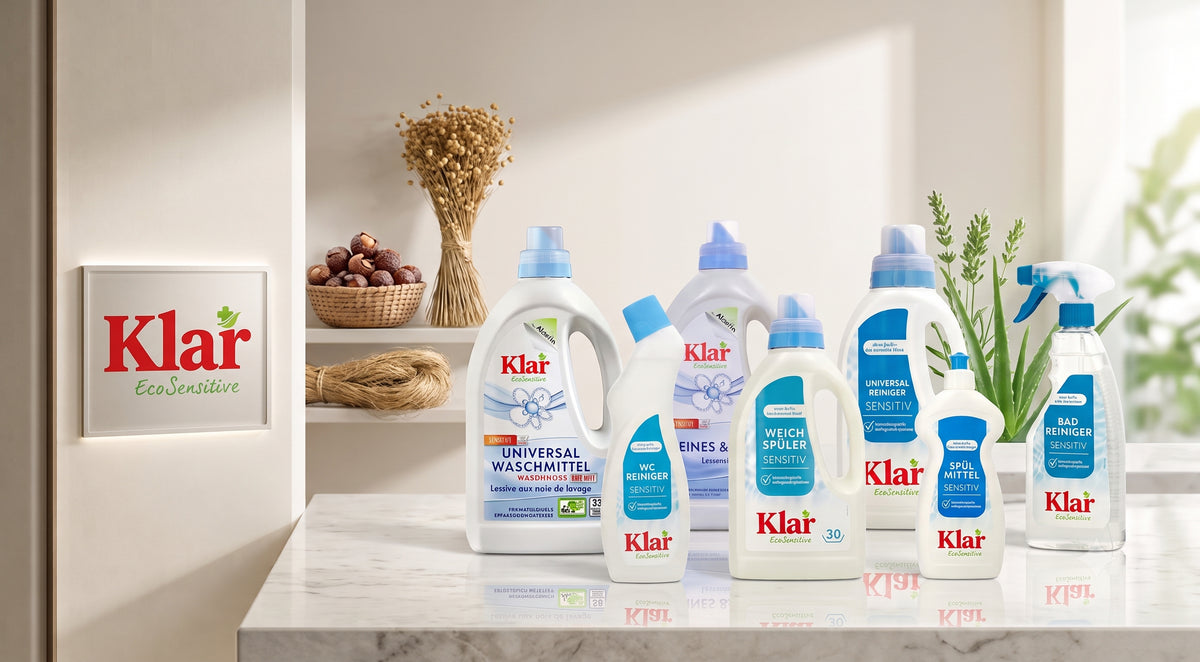
Eco-Friendly Cleaning Products Available in Singapore
Seven Klar products currently ship in Singapore, covering laundry, kitchen, bathroom and general cleaning.
| Room | Product | Size | Certification |
|---|---|---|---|
| Laundry | Universal Laundry Detergent, soap nut based | 1,500ml | Ecogarantie, DAAB |
| Laundry | Fine Fabric and Wool Liquid Detergent | 500ml | Ecogarantie |
| Laundry | Fabric Softener | 750ml | ECOCERT |
| Kitchen | Dishwashing Liquid | 500ml | Ecogarantie |
| Kitchen | Creamy Kitchen Cleaner | 500ml | Ecogarantie |
| Bathroom | Bathroom Cleaner | 500ml | Ecogarantie |
| Cleaning | All-Purpose Cleaner | 500ml | Ecogarantie |
Every product in the range is fragrance-free, vegan and dermatologically tested.
Browse the full range
Shop All Klar Eco-Friendly Cleaning Products →
Building an Eco-Friendly Cleaning Routine, Room by Room
You do not have to replace everything at once. Most households find it easier to switch one room at a time, starting with whichever product they use most.
Laundry
The highest-impact switch, because detergent residue stays in fabric that sits against your skin all day. The Universal Laundry Detergent uses soap nut saponin as its main cleaning agent and works as a 3-in-1: detergent, fabric softener and ironing aid. It runs from 20°C to 95°C on whites, colours and darks.
Kitchen
The Dishwashing Liquid is highly concentrated, with plant-based surfactants and glycerine that help protect hands during daily washing up. The Creamy Kitchen Cleaner is a fragrance-free scouring cream with calcium carbonate and bentonite clay for jobs that need gentle abrasion.
Bathroom
In a small, humid, often windowless Singapore bathroom, what you spray is what you breathe. The Bathroom Cleaner dissolves limescale and soap residue with citric and lactic acid, using six ingredients and no added fragrance.

Everywhere else
The All-Purpose Cleaner covers everyday surfaces with a mildly alkaline formula, 100% naturally derived, for the surfaces an acidic bathroom cleaner should not touch.
Eco-Friendly and Low-Irritant Are Not the Same Thing
Worth separating these, because they get bundled together and they are different claims.
A product can be excellent for the environment and still irritate sensitive skin. Essential oils are plant-derived and biodegradable, and they are also among the more common fragrance allergens. Plenty of eco brands scent their products with citrus or lavender oils, which is fine for most people and a problem for some.
If someone in your home has sensitive skin, a respiratory condition, allergies or atopic skin, or if there is a newborn, a pregnancy or an elderly family member in the house, the claim to look for is fragrance-free, meaning no fragrance added at all, synthetic or natural. That is a narrower set of products than "eco-friendly", and it is the category Klar was built for.
Two different questions
"Is this good for the planet?" is answered by certifications like Ecogarantie and ECOCERT Greenlife. "Is this gentle on the people in my home?" is answered by fragrance-free formulation, dermatological testing and seals like DAAB. The strongest products answer both.
Frequently Asked Questions
What are the best eco-friendly cleaning products in Singapore?
The ones worth buying share the same markers: a published full ingredient list, a named independent certification such as Ecogarantie or ECOCERT Greenlife, readily biodegradable formulas, no synthetic fragrance or dyes, and recycled recyclable packaging. Klar EcoSensitive, a German range by AlmaWin, meets all of these and is available in Singapore at klarasia.com across laundry, kitchen, bathroom and general cleaning.
Do eco-friendly cleaning products actually clean as well?
The credible ones do, and some certifications require proof. Ecogarantie mandates performance testing, so a certified product has had to demonstrate it actually cleans, not only that it is gentle. Where eco products sometimes disappoint is dosing: concentrated formulas need a different amount from what you are used to, and using too little is the usual reason a switch feels underwhelming.
What certifications should I look for on eco-friendly cleaning products?
Ecogarantie and ECOCERT Greenlife certify the product itself. GREEN BRAND is an EU-protected guarantee mark awarded to the brand and reassessed every two years. EMAS III, DIN ISO 14001 and DIN ISO 9001 certify how the manufacturer runs its operations. DAAB, the German Allergy and Asthma Association, is the hardest of these to obtain, signals suitability for sensitive households, and is awarded product by product. Locally, the Singapore Green Labelling Scheme certifies across several categories. A claim that names no standard, no certifying body and no registration number is not a certification.
What is greenwashing and how do I avoid it?
Greenwashing is presenting a product as environmentally responsible without substantiating it. The quickest defences: check for a full ingredient list, check for a named certification rather than a generic green logo, and treat unregulated phrases like "natural" and "non-toxic" as marketing until something backs them up.
Are eco-friendly cleaning products better for sensitive skin?
Often, but not automatically. Eco-friendly describes environmental impact; it does not guarantee a formula is low-irritant, and natural fragrance ingredients such as essential oils can still trigger reactions. For sensitive households, look specifically for fragrance-free and dermatologically tested products.
What is the difference between fragrance-free and unscented?
Fragrance-free means no fragrance was added to the formula, synthetic or natural, essential oils included. The product may still carry a faint natural scent from its own ingredients. Unscented describes how a product smells, not what is in it, so an unscented product can contain a masking fragrance added to cover raw material odours. Check the ingredient list for "Fragrance" or "Parfum".
What does "dermatologically tested" actually mean?
It means the formulation was tested on the skin of volunteer subjects by an independent institute, at the dilution the product is normally used at, in a procedure similar to an allergy test. For AlmaWin and Klar, only formulations that pass without issues are brought to market. It is a test of skin tolerance, not a claim that a product is suitable for a diagnosed skin condition.
Where can I buy eco-friendly cleaning products in Singapore?
Klar products are available exclusively through the official Klar Asia store at klarasia.com. Singapore orders ship in 2 to 3 business days with free shipping over SGD 50. We also ship to Malaysia.
Certified, not just claimed.
German eco-certified cleaning, fragrance-free across the whole range. Free Singapore shipping over SGD 50, and a Value Pack of 6 saves 20%.
Shop Klar Eco-Friendly Cleaning →